
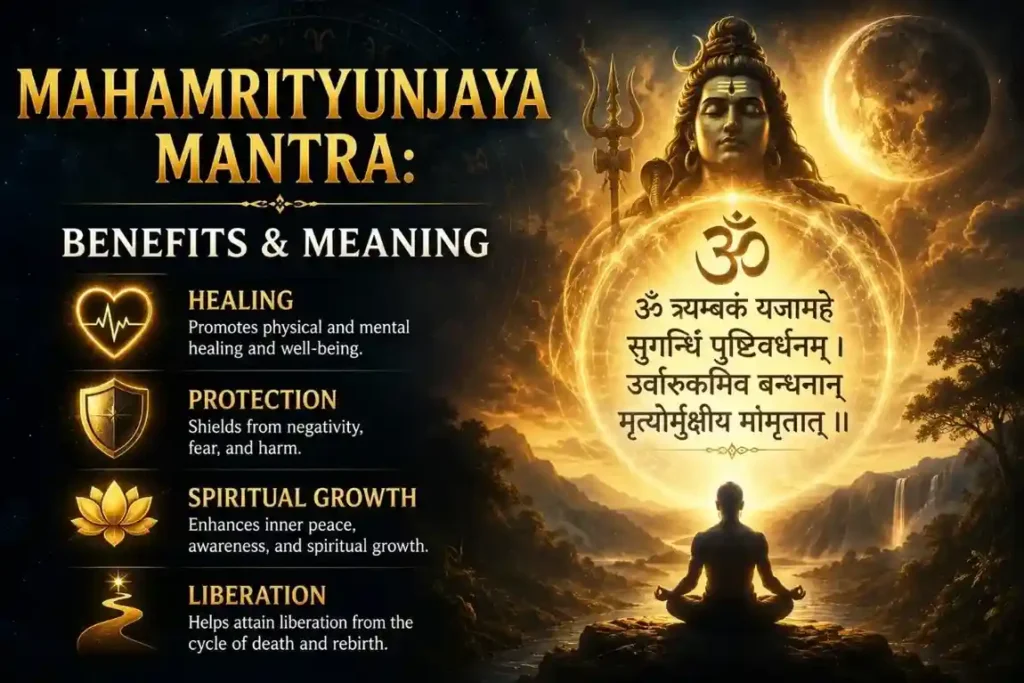
There’s a moment almost everyone goes through at some point a scary health scare, a loved one in the hospital, or just one of those nights where your mind won’t stop spinning with worry. It’s usually in moments like these that people first hear about the Mahamrityunjaya Mantra. It’s one of the oldest mantras in Hindu tradition, dedicated to Lord Shiva in his form as Mrityunjay, the conqueror of death.
People have leaned on this mantra for thousands of years, long before any of us were around to ask why it works. Some chant it themselves every morning. Others, especially during a serious illness or a difficult astrological phase, prefer to have it done properly by someone trained in it. Either way, it’s worth actually understanding what you’re chanting and why so let’s go through it properly.
What is the Mahamrityunjaya Mantra?
This one comes straight from the Rigveda, and it also shows up in the Yajurveda, so we’re talking about something genuinely ancient here not a modern addition. It’s addressed to Shiva, and across centuries it’s become one of the go-to mantras for anyone facing illness, fear, or the simple dread of mortality.
The verse itself goes:
Om Tryambakam Yajamahe Sugandhim Pushti Vardhanam Urvarukamiva Bandhanan Mrityor Mukshiya Maamritat
Roughly translated: we bow to the three-eyed Lord Shiva, who is gracious and who nourishes all living beings. Just as a ripe cucumber falls effortlessly away from its vine, may He free us from death and bless us with a long, healthy life.
That cucumber line trips people up at first it sounds like an odd thing to compare death to. But sit with it for a second. A ripe fruit doesn’t get torn off the vine. It just let’s go, naturally, when it’s ready. That’s the whole point of the mantra: it’s not asking for death to be avoided forever, it’s asking for a release that’s gentle instead of violent, whenever that time comes.
Significance of the Mahamrityunjaya Mantra
There’s an old story attached to it a young man named Markandeya, whose life was supposedly already claimed by Yama, the god of death, was saved through this very mantra. That legend is part of why it’s also called the Mrita-Sanjivani Mantra, or sometimes the Rudra Mantra.
Whether or not you take the legend literally, the mantra is still used today for things like:
- Calming the fear of death itself
- Helping someone recover from a serious illness
- Reducing the effect of what astrologers call Mrityu Dosha a chart indication tied to early death or danger
- Supporting a longer, healthier life
- Building a closer, more personal bond with Shiva
Benefits of Chanting the Mahamrityunjaya Mantra
This is the part most people want to know about, so let’s get into it honestly rather than just listing claims.
If someone’s going through a frightening medical situation a surgery coming up, an unexpected diagnosis, a rough patch astrologically this is often the mantra families turn to for protection. It’s not a replacement for medical care, but alongside it, many people say it gives them something to hold onto.
For people dealing with a long illness, the mantra is often chanted not instead of treatment, but next to it a way of giving the person (and the people around them) some sense of strength while the body does its work of healing.
Then there’s the calmer, quieter benefit: peace of mind. Chant these enough times, slowly, with attention to the sound rather than rushing through it, and most people notice their breathing slows down too. Sleep gets a little easier. The constant low hum of anxiety eases up, even if just a bit.
For some, it’s less about a specific problem and more about Shiva himself a way of feeling close to something bigger than the day’s worries, and slowly learning to let go of things that were never really in their control to begin with.
It’s also used as a kind of energetic clean-up to clear a home of bad energy, undo the effects of an evil eye, or shift a stretch of bad luck around health, money, or relationships.0
And astrologically, if your chart shows Ayushya Dosha something related to lifespan or you’re moving through a heavy planetary period, this is one of the remedies that comes up again and again.
How to Chant the Mahamrityunjaya Mantra
Here’s where people often go wrong without realizing it pronunciation in Sanskrit isn’t just a formality. The sound itself is believed to carry the effect, so saying it correctly actually matters.
A few practical points if you’re chanting on your own:
- Time of day: early morning, ideally between 4 and 6 AM (Brahma Muhurta), or during the evening prayer hour
- Count: 108 times a day with a Rudraksha mala is the standard for regular practice; for a specific problem, priests sometimes prescribe far higher counts, running into the lakhs
- Setup: face east or north, sit on a clean mat wool or kusha grass traditionally ideally after bathing
- What helps: doing this in front of a Shiva Lingam, with bilva leaves, water, and a lit diya
- Consistency over intensity: 40 straight days (a “mandala”) is the traditional length people commit to before expecting any real shift
None of this is complicated, but it does take discipline and getting the pronunciation wrong, repeatedly, over weeks, isn’t something most people want to risk when the whole point is to do this properly.
Mahamrityunjaya Jaap in Ujjain
You can chant this mantra anywhere your home, a temple near you, anywhere quiet enough to focus. But there’s one place that keeps coming up whenever this mantra is discussed seriously: Ujjain.
The reason is the Mahakaleshwar Temple, one of the twelve Jyotirlingas, where Shiva is worshipped specifically as the lord of time and death. Given that the entire mantra is about conquering death, chanting it in a place where Shiva is worshipped in exactly that form isn’t a coincidence people take lightly. This is why so many devotees specifically plan a Maha Mrityunjaya Jaap in Ujjain rather than doing it at home they want the ritual performed where it’s believed to carry the most weight.
Why You Should Hire an Experienced Pandit
Here’s the honest truth: this isn’t a casual mantra to wing on your own, especially if you’re doing it for a serious reason a health crisis, a major dosha, something with real stakes attached. The pronunciation has to be right, the intention (sankalp) has to be set properly, and the sequence of the ritual matters. Get any of that wrong consistently, and tradition holds that the effect weakens.
That’s exactly why, if you’re arranging this in Ujjain, it’s worth the extra effort to find the best pandit in ujjain rather than just picking whoever’s available. You want someone who’s actually done this many times before who knows the temple’s procedures, has performed Mahamrityunjaya Jaap and Havan rituals repeatedly, and can carry out the whole thing exactly as it’s meant to be done.
Conclusion
At the end of the day, this mantra has survived for thousands of years because it does something real for the people who chant it whether that’s a sense of protection, a little more strength during illness, or just quiet peace on a hard night. You don’t need to overthink it. Chant it yourself if that feels right, or have it done properly by someone experienced in a place like Ujjain if the situation calls for it.
Either way, it deserves to be done with care the right words, the right intention, and enough patience to let it actually work.